Get Started


Key Takeaways
Nearly three-quarters (73%) of agency professionals consider optimizing websites for automated systems to be a structural shift equal in magnitude to the mobile web transition. Failing to adapt risks an immediate loss of search visibility and market share for your clients.
A distinct market maturity gap currently exists, with 26% of firms operating as proactive industry leaders while 15% remain reactive beginners. These leading agencies are three times more likely to offer advanced technical services and secure high-value enterprise accounts.
Transitioning the agency business model from delivering commoditized execution tasks to providing strategic technical consulting is critical for long-term survival. Industry research indicates that 34% of firms are already creating new, specialized service offerings strictly for machine consumers, but the key is proactively leading your clients where they need to be.
Standardizing internal development stacks protects agency profit margins by eliminating unmanageable technical debt across fragmented legacy systems. Reclaiming these non-billable hours empowers engineering teams to focus entirely on high-value architectural consulting and proactive client retention.
Seventy-three percent of agency professionals agree that optimizing websites for automated systems is a structural shift comparable to the adoption of mobile-responsive design. According to WP Engine’s recent report The Next Wave: How AI is Changing the Digital Agency Model in Building Websites For Both Humans and Machines, the industry is actively splitting between proactive innovators and reactive maintainers.
The digital landscape is undergoing a massive architectural transformation. At this time, just like the mobile-first era, brands are looking for expertise and strategic guidance in navigating this period so they aren’t left behind.
Agencies play a significantly valuable role for brands at times like this. Those that are able to lead strategically and technologically develop expertise and authority to the same extent as the agencies that responded quickly to solving the mobile-first need.
By updating their technical approach and modernizing their tech stacks, firms can transition from execution-based vendors to strategic, high-value technical partners, securing long-term stability and predictable revenue in a volatile market.
This is no longer a conversation about simply adding a new generative text tool to a copywriting workflow. It is a fundamental shift in how digital experiences are constructed, how agency business models operate, and how technical value is sold to clients.
The historic mobile-responsive parallel
To understand the magnitude of the current shift, we must look at recent history. The transition to mobile-first was not merely a design trend; it was a fundamental change in how websites were engineered. Looking at how agencies responded during that time provides a blueprint for how to lead during the AI era.
The structural mandate
Responsive design forced a complete overhaul of web architecture, much like the agentic web does now. Agencies that quickly adapted to fluid grids and media queries, and led boldly, won some of the highest-value contracts of the decade. Those that hesitated were often forced to compete strictly on price.
A brief history of the web
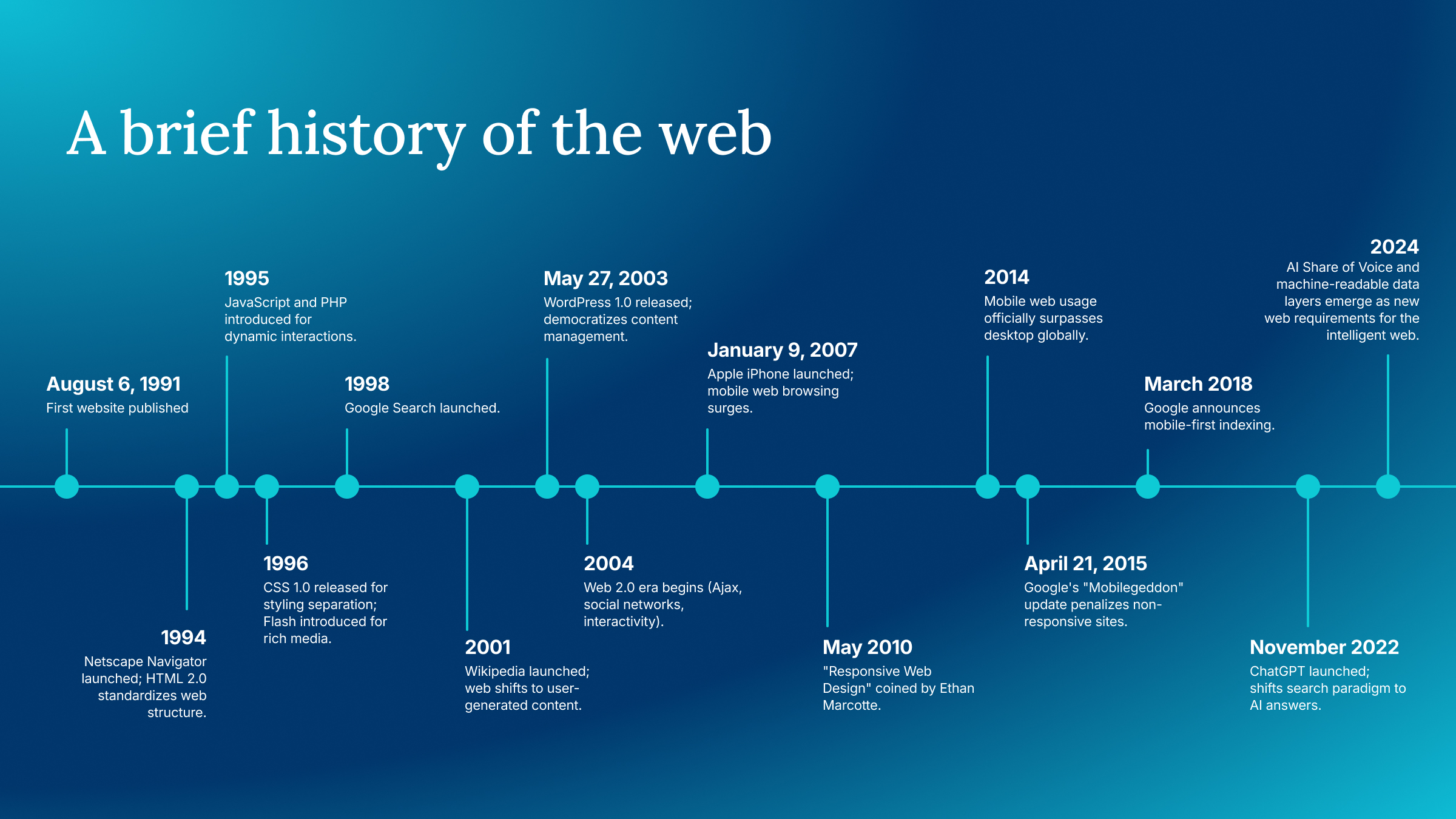
Tracing the timeline of website evolution over the past 30 years, we see a consistent pattern of infrastructure shifting to meet new consumer habits. Ethan Marcotte’s seminal article for A List Apart, which coined the term “responsive web design,” drew the line in the sand for this profound shift.
Responsive design, and the needed architecture, quickly became the standard for the web today. Despite design firms seeing this new reality, many clients did not explicitly ask for responsive design because they did not understand the underlying technology. Proactive agencies built it into their proposals anyway, knowing it was a structural requirement for future success.
Today, in the era of AI, the requirements are machine readability and API-first data structuring. We are moving away from building solely for human interaction and toward a dual reality where sites must also be perfectly legible to automated answer engines, large language models (LLMs), and AI crawlers.
The long-term cost of late adoption
Historically, waiting for mobile responsiveness demand from clients actually cost agencies their authority in the market. Clients churned, enterprise prospects looked elsewhere, and eventually, agencies took their clients through costly migrations and redesigns to responsive designs once the client’s needs caught up.
Just as mobile usage statistics forced layout changes and web architecture changes, documented in Pew Research Center’s historical data on mobile adoption, the current rise of automated answer engines is forcing changes to the data layer. Eventually every client will ask for this, but if you wait for them, it may be too late.
Waiting for clients to understand new technology and request back-end restructuring is a massive risk. If a client’s site loses visibility because it is not optimized for modern discovery platforms, they’ll likely blame the agency, increasing the risk of churn. As strategic partners, agencies should guide their clients toward what they need technically, long before the client recognizes the business requirement.
The widening gap between leaders and laggards
WP Engine’s report found a stark contrast in how agencies are approaching this new era. The industry is not moving uniformly; instead, a significant maturity divide is quickly reflecting which firms are growing and which are struggling to maintain their margins.
Defining the modern technical leader
For instance, WP Engine’s Next Wave report identified 26% of agencies as leaders who integrate these tools deeply, versus 15% as laggards. Leaders operate proactively. They redesign their tech stacks to meet future demands, invest in upleveling their skills, and actively pitch new services.
In fact, the report shows leaders are three times more likely to already be offering advanced technological services. This sets them up to land high-value projects and clients who already know they need these changes. It also allows them to deepen relationships with existing enterprise clients who depend on the firm’s consultative advice. Meanwhile, agencies who are waiting for explicit client requests are quickly falling behind and may be operating out of fear of making the wrong technical choice.
The Stanford AI Index Report demonstrates the rapid enterprise demand for these advanced capabilities. Clients expect their digital partners to provide modern, compliant, and highly secure solutions. Early technology adoption strongly correlates with sustained market leadership, a concept validated by insights from MIT Technology Review. Agencies that adopt these capabilities early distinguish themselves in competitive request-for-proposal processes, winning larger enterprise accounts.
Overcoming the fear of rapid change
Keeping up with the rapid pace of change is the top challenge cited by 41% of surveyed agencies in the report. More than just a challenge, it’s easy to get overwhelmed, especially the further you fall behind. This makes constant learning and skill upleveling a non-negotiable for agencies who want to lead in this era.
Leaders can overcome this fear by building structured evaluation processes, automating processes to create greater efficiency, and standardizing their core technical stack. Together these efforts help create a culture of innovation by giving the time and space needed to focus on strategic learning and changes. An internal culture that values learning, structured experimentation, and innovation can also help protect your team from burnout as your agency evolves.
Architecting for a new standard
The architecture of the web is fundamentally changing to support both machine consumers and human users. Innovative agencies are evaluating their options in light of both the current requirements and the need to stay agile as AI technology evolves.
The shift to API-first and decoupled environments
Adopting a composable architecture separates elements of a digital property to ensure the right technology is used for each task. For instance, a headless site decouples the front end of a website from the content management system. This approach allows the underlying data and content on the back end to be served up via lightning-fast APIs to any device, browser, or automated agent. This paves the way for AI agents to have greater visibility and context for their LLMs than a site created for human users.
Building for dual audiences improves user experience
Beyond the back end, the human experience is also evolving thanks to these changes, providing immediate value to clients and users alike.
For instance, implementing tools like WP Engine Smart Search modernizes product and information discovery for the users, AI-powered site search provides fast, highly relevant results, leading to increased conversion rates and user engagement. As users have become accustomed to sophisticated, AI-driven search tools in their daily lives, sites with rigid, exact-match legacy search bars are pushing them to spend their time and their money elsewhere.
Realigning your agency
The value that digital agencies deliver is fundamentally changing. This is not simply a matter of learning a new coding language, creating a few new offerings, and spinning up a new pitch deck. Leading in this new reality requires a deep, structural shift in an agency’s culture, how it structures both talent and operations, and how it approaches the client relationship.
Transitioning from vendor to strategic partner
This is more than just changing your offerings. Agencies need to move from execution-based models that create a repeatable set of deliverables to that of a trusted strategic advisor who guides their clients into the future.
When automated systems can generate the baseline deliverables that used to fill agency invoices such as first drafts, basic quality assurance, and simple code generation, the production layer becomes commoditized. If an agency only bills for the hours spent typing code, their perceived value and ability to innovate will drop. The alternative is framing your work less around commoditized output and more in terms of your specialized knowledge and experience. By doing so you not only protect your margins, you position your agency and your employees as indispensable and worth premium hourly rates.
This impacts organizational charts, job roles, and culture. The World Economic Forum’s Future of Jobs report expects AI adoption to drive changes to the structure of 60% of businesses by 2030.
This realignment is likely to touch agencies of all sizes. Whether it’s platform choice, internal processes, specific technology choices, or team structure, all of it will need to flow from a commitment to innovative implementation, technical agility, and constantly exploring the future of the intelligent web.
By positioning your firm as an expert in machine-readable architecture and intelligent web design, you justify premium pricing and elevate your agency from a commodity vendor to an indispensable strategic partner.
Client education
Understanding the technical requirements is only half the equation; you need to convince clients how important they are. Often this will require showing them how past work you’ve done for them is no longer effective. But the alternative of just building for legacy SEO tactics in the age of AI visibility will do more harm than good at this point.
When pitching to skeptical clients, it will be critical to frame these updates around measurable business outcomes: risk mitigation, search engine visibility, and long-term total cost of ownership. Clients understand the business value of protecting their digital footprint and likely have already seen a reduction in clicks and on-site engagement. They may not fully grasp the intricacies of JSON-LD or API endpoint optimization, but they comprehend the threat of becoming invisible in modern search results.
Moving to modern, dual-audience architecture now prevents the need for a costly, reactive rebuild once the damage is already done, but in an environment of shrinking budgets, clients will need to see the immediate needs as well.
Next steps
The window to establish your agency as an early adopter is closing rapidly. However, capitalizing on this moment requires more than adopting new software; it requires a fundamental change in your agency’s culture.
Agency leaders must transition their teams from a mindset of execution and order-taking to proactive strategic consulting. This means training your staff, from account managers to lead developers, to understand the dual reality of the web. When your entire team understands how to build for both human interaction and machine consumers, your approach to client work completely changes. You stop selling “websites” and start selling “intelligent digital foundations.”
Start by auditing your own internal processes. Are you still billing primarily for deliverables that automated systems can now generate? If so, you must quickly repackage your value around strategy, trust, and data architecture.
Once your internal mindset is aligned, audit your top three clients’ technical stacks this month. Look for fragmented data, slow server response times, and a lack of structured data markup. By initiating these conversations proactively, you shift your relationship from a commodity vendor to an indispensable partner, securing long-term retention and predictable revenue for your agency.
Frequently asked questions
How do we convince clients of these needed architectural upgrades when they haven’t asked for them?
Frame the updates in the context of the mobile responsiveness change. Remind them of the businesses that stubbornly clung to desktop-only layouts and subsequently lost massive amounts of market share and customer trust.
This requires a cultural shift in how you manage accounts: do not wait for the client to diagnose their own problem. Ensure clients know this conversation is about risk mitigation, visibility in the era of artificial intelligence, and long-term total cost of ownership. It is your responsibility as their strategic partner to address this now, rather than revisiting it once competitors have adapted and your client has already lost market share.
What is the first step to becoming a technical leader in this space?
Standardize your development stack to ensure all new builds meet modern API and data-structuring baselines. Becoming a technical leader starts with a cultural refusal to accept unmanageable technical debt.
You cannot scale a high-value strategic offering if your team is constantly putting out fires across fragmented hosting environments. Eliminate fragile legacy systems from your standard offerings. By partnering with a reliable technology provider that handles the infrastructure, security, and performance tuning, your team can reclaim their time. This operational shift not only lowers your total cost of ownership, it empowers your agency to focus entirely on delivering the strategic architectural consulting that high-value brands demand.