
WP Engine Supports the Future of WordPressⓇ Through 6.9 Contributions
WP Engine is proud to have supported some of the individuals who dedicated their professional talents to the final major release of the year, WordPressⓇ[1] 6.9, which arrived on December 2, 2025, closing out a year of continuous progress for the open source project that powers over 40% of the web.
As one of many participants in the WordPress ecosystem, which has grown in both size and complexity, WP Engine contributed to the vast, coordinated effort aimed at maintaining and improving the project.
What’s included in WordPress 6.9?
WordPress 6.9 is the final release planned for 2025. It delivers a myriad of new features, maintenance items, user improvements, developer enhancements, and performance updates. A few of the highlights include:
New features we’re excited about
Contributors helped to refine the Site Editor with a simplified editing mode for users who want to make fast text and image updates without the hassle of complex styling options, as well as the ability to hide blocks from the frontend while keeping them visible in the editor.
The release introduced new core blocks, like an accordion block for collapsible sections and a terms query block for displaying taxonomy terms.
6.9 also brings accessibility improvements, such as improved screen reader notification, better color contrast, and expands the Command Palette across the entire dashboard.
Developer and performance updates
For developers and high-volume sites, the 6.9 release includes foundational updates crucial for scalability and the future of the platform:
Contributors refined several APIs to give developers more control, including improvements to the Block Bindings API, DataViews and DataForm components, and the Interactivity API.
The new Abilities API has standardized how plugins, themes, and WordPress core register their capabilities, providing clear inputs, outputs, and permissions that AI tools can understand. This ensures WordPress is ready for discoverability and interaction with the agentic web.
The new release also introduces significant speed and performance enhancements by increasing the inline style limit to 40KB, minifying block theme styles, and omitting styles and scripts for hidden blocks by default. These updates reduce render-blocking, translating into faster page loads and improved Largest Contentful Paint (LCP) metrics.
How did WP Engine contribute to 6.9?
WP Engine views all its community contributions as investments in the success of both its customers and the wider web.
WP Engine team members are proud to carry on the company’s long tradition of contributing to both WordPress core and the wider community, and were especially excited to increase their core contributions in this release.
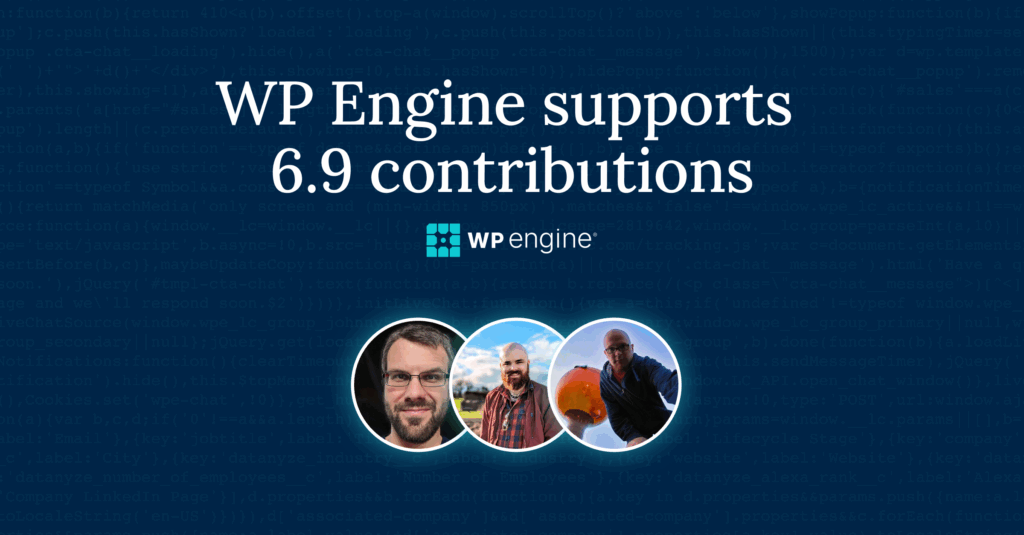
For the 6.9 release, WP Engine sponsored the work of three Core contributors. The team consisted of Callum Bridgford-Whittick, John Parris, and Weston Ruter.
Data from October 2025 showed that WP Engine was the second-largest corporate contributor during the month, with Weston Ruter leading the charge. He contributed 43 of the 192 total commits to core in October.
Tackling ticket triage
Not all contributions to an open source project are as glamorous as a commit to the core software. Some of the most crucial work can also be the most tedious, often in the form of ticket triage.
The WordPress project is managed by the community through a system of tickets that log everything from bug reports to feature requests. With thousands of open tickets, some untouched for years, identifying the most relevant issues can be a massive drain on contributor time. This is the kind of work Callum and John initially focused on.
“It’s not always the most exciting work,” said John Parris, who started triaging tickets back in April, “but we know it’s important to the project’s health to start doing this.”
Sifting through this backlog is an essential service. Contributors must review each ticket to determine if the issue has been resolved elsewhere or if it’s even relevant to the project of today. For example, Callum mentioned that there are still lots of tickets related to the classic editor.
“It’s just going through a lot of testing on old tickets to make sure they’re still relevant,” he said, “and if they’re not, it’s getting them off the system, so there’s more space to look at new tickets.”
By clearing out the digital clutter, it becomes easier for every other contributor to work on the tickets that truly matter. This kind of consistent, dedicated effort to managing the “less exciting work” is invaluable to the continued progression of the WordPress project.
Why these contributions matter
For agencies and developers, stability, clean code, and performance optimizations mean less time fighting bugs and more time building client projects.
For businesses, a faster, more reliable CMS means better experiences for site visitors, which can translate into higher conversions, lower bounce rates, and improved discoverability.
Ultimately, the community contribution model is a symbiotic relationship. As Weston Ruter puts it, a company’s financial investment in full-time contributors becomes a “win-win-win situation.” Dedicated contributions ensure a better, faster open web for the public, a more robust platform for organizations and customers using WordPress, and a stronger foundation for ecosystem partners like WP Engine.
Sponsorship of full-time contributors demonstrates one of the most impactful ways companies like WP Engine can responsibly contribute to the project that ultimately drives our collective success.
Contributions create progress for all
WP Engine believes that the success of the WordPress project is intrinsically linked to the health of its community. While countless volunteers have contributed to its growth, the sheer scale and complexity of a CMS that powers more than 40% of the web requires deep, sustained commitment.
From clearing out old tickets to leading the charge on new performance features, the work of Callum, John, Weston, and every other contributor strengthens the future of WordPress for all users.
WP Engine is committed to supporting the maintenance and growth of WordPress, now and into the future. Our contributor team is excited to continue their essential work into 2026 and beyond, ensuring the open web remains robust, secure, and performant for everyone.
1WP Engine is a proud member and supporter of the community of WordPress® users. The WordPress® trademarks are the intellectual property of the WordPress Foundation, and the Woo® and WooCommerce® trademarks are the intellectual property of WooCommerce, Inc. Uses of the WordPress®, Woo®, and WooCommerce® names in this website are for identification purposes only and do not imply an endorsement by WordPress Foundation or WooCommerce, Inc. WP Engine is not endorsed or owned by, or affiliated with, the WordPress Foundation or WooCommerce, Inc.
Start the conversation.